Jonas Bablinskas was born in the Vaitkuškis manor near Ukmerge. His father, Peter, was a soldier of the Kossakowskis regiment, and his grandfather was born into slavery (surf) but was free in 1861. His father, Peter, served 25 years in the Russian army. Peter, along with the entire population of young me were forcibly conscripted into the Russian army because of the rebellion of 1861. Peter would of participate in the action known as the Russian-Turkish War of 1879. Because of Peter’s service in the Russian Imperial Army, John (Jonas) is allowed to attend grammar school. Of course, they will only teach him the Russian language and the Cyrillic alphabet; if he wants to learn Lithuanian in the Latin alphabet, he will have to conduct it at home or with his priest in secret, as teaching the Lithuanian language is against the law. So the reason I never found him in Canada is because john signed his name Баблінскас , or (Jonas Gogrihckac)
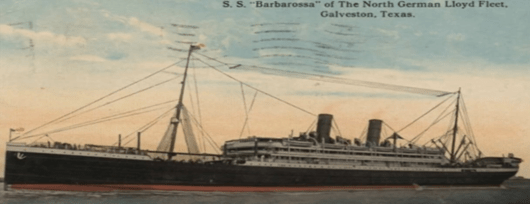
April 9, 1912, in Halifax, Nova Scotia, Canada, the SS Barbarossa is disembarking its 996 steerage passengers. Before it heads to New York Harbor on April 12, it is seven days before the Titanic sets sail. Jonas Bablinskas and his friend Joesph Misinisk wait in line for a final inspection. They are two of five Lithuanians on board at their control station in Galatia, Southern Poland. They received their paper to transit to the Grand Trunk Railway to be laborers. They are contract laborers and have signed a contract to work for the Grand Trunk Railway for five years in exchange for their passage to Canada. They consider themselves the lucky ones. The transit station is in southern Ukraine, near Krakow. So they had to walk about 500 miles South to be one of the people they would pick to be workers. The Canadian Pacific Railroad spread the word throughout the villages and towns of the Russian Empire, inviting Ukrainians to work for them on the railroad.
There was a railroad strike, which had been going on since 1906. So the railway president decided to take decisive action to build his road by hiring eastern Europeans, especially Ukrainians, as he was informed, “Ukrainians are hard workers accustomed to conditions on the prairie .” The President of the Grand Trunk Railway is Charles Melville Hayes. We can only speculate whether he is there to oversee the selection personally. We do know that Hayes was a hands-on manager. His European mission is to select Ukrainian workers as union labor disputes slowed progress in western Canada. Charles Hayes will be on the Titanic’s maiden voyage and go down with that ship.
Grandpa John and Joe Miskinisk found one of the following posters distributed throughout Eastern Europe, specifically in the Ukrainian-speaking areas. It advertises the need for workers to come to Canada. To work for the railway. And we’ll go to build towns on the western Canadian Prairie. They are the navies, the lowest-paid workers. The average pay is $1 a day. They will dig ditches, pound railroad spikes, set up tracks, and blow up boulders. They will do all the work that the Canadians and English will not do, so Canadians and English will purchase Ready-made farms that the railroad will build.
Of course, Ukrainians and Lithuanians cannot apply to purchase these farms; only English-speaking Canadians need apply. John and Joe will live in tents on the Canadian prairie. One of these tent cities was built by workers from his ship in the spring of 1912 in Rosemary, Alberta, Canada. They work from sunup to sundown to first plant wheat. They signed the paper promising to work five years for the Grand Trunk Railway in exchange for their passage to America. For 20-year-old Jonas and 18-year-old Joseph, this adventure started with a poster. They were young and ambitious; Lithuania had no work, and people were starving. The poster printed in Ukrainian calls for workers, farm laborers, and railroad workers to work on the Canadian Pacific Railway or Grand Trunk Railway in exchange for five years of service and farm work.
At some point between 1913 and 1915, there was an accident, which was not surprising. His manual labor put him into contact with explosives, and accidents were a daily occurrence. And they were blowing up tunnels, the Connaught tunnel through Mt. Macdonald. This Is the longest railroad tunnel on this continent, and the work was completed a year sooner than expected in 1914, which cost the lives of 27 Immigrants. The Connaught Tunnel accomplishment is a triumph of engineering and labor seldom equaled in the world’s history. The tunnel Is the longest double-track tunnel in the Western Hemisphere. The length is about five miles, the time the work was performed. In two and a half years,
constituting a world record, the number of men employed was about 6000. The tunnel will eliminate several miles, considerably reduce the distance connecting railway points, and affect a significant grade reduction. The cost of the tunnel was $6,500,000.
We can only speculate that John perhaps broke his leg there, and somehow, he and Joe wound up in Montreal by the end of 1914
MONTREAL. —Easter Sunday, April 14, 1915, is boiling, and the temperature in New York City is 91 degrees. The temperature in Montreal is 89 degrees. The hot spring will make the Saint Laurence River feel like swimming in a summer lake. On Tuesday, June 1, John prays in the French church of St. Catherines on Shepherd St. in Montreal, Canada.
His name is registered as Jonas Gogrihckac, but his real name is Jonas Baublinskas. But because of his Russian elementary school education, he was taught only to write in Cyrillic, where the letter “B” looks like the letter “G,” and the letter “N” looks like the letter “H.” The letter “S” looks like the letter “C.” So, at the transfer station in Krakow, Poland, he wrote down his name and how he learned to write. The way he always wrote down his name Баблінскас.
The idea of John escaping to the USA is entirely plausible. The Canadian government passed the War Measures Act. It was passed in 1914, barely 30 days after the beginning of World War One. The paranoid Canadians felt that anyone who spoke a foreign language could be a German or Austrian spy. So, they began arresting Germans and Austrians, Ukrainians, Polish, and everyone that spoke a different language, including the Lithuanian Jonas. To the paranoid, Canadians didn’t know the difference; all eastern Europeans are not to be trusted.
Grandpa Johns’s path of escape would have started at the old immigration hall, which at the time was right next to the Saint Lawrence River and across from the railroad freight yards of the Grand Trunk railroad. This is an area he would have known well. It would have been a leisurely swim hopping across the various islands on that scorching spring day. Reaching the other side of the Saint Lawrence River opposite Montreal, the southern bank of the Saint Lawrence River was a very underdeveloped area and wooded in 1915. As long as he traveled by night, it would have been a simple matter of following the railway tracks to Malone, NY, and the United States—a distance of 90 miles. He arrived in Malone, NY, on June 2, 1915.
Discover more from Site Title
Subscribe to get the latest posts sent to your email.
