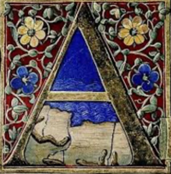
Aldrich the monk, looks out the window of the monastery of Saint Sebastian in the north of England. The snow falls and creates beautiful patterns in the bare brown fields and treeless branches. This monastery makes Illuminated manuscripts to teach an impoverished, very illiterate population the story of Christ and guide them to salvation. But today, he doesn’t feel very excited. Today, he is doing more drudgery and copying another text from an old Pagen Papyrus Scroll. He’d instead copy the Gospel of Saint John like his friends. “I’m stuck doing this Pagan nonsense.” Well, that’s what he calls it under his breath anyway. The temperature drops drastically as the wind picks up, biting at any exposed skin. The tension in the air is palpable, causing hairs to stand on end and goosebumps to appear.
The snowflakes fall gently onto the monk’s face, melting his skin and leaving a chill in their wake. As he walks, the crunch of the snow beneath his feet reminds him of the passing of time and the fragility of life—the coldness of the outside seeps into the monastery despite the warmth of the fire. The monk can feel the chill seeping into his bones, a discomfort that mirrors the unease in his heart.
It was still dark outside, and soon, the sun would come up, although rather meekly, and he would head over to the scriptorium. To finish the Latin text, he’s been working on for the last ten weeks. No one reads it anymore. It’s written in the old Britton Romance language. A language so ancient all have forgotten what it was called, but to those who read and write Latin, it is barely decipherable. Aldrich understands because his mother was a Britton. It has been a good century since the Romans left the island. Still, fewer people even read and write anymore. His mother told him the stories of Roman law and order and civilization. When there was no need to build walls and defend yourself against your neighbor, he thought that was a better time, even though pagans were living about. His mother, a converted Christian, would still gather flowers and put them at the Old Temple of Artemis on the anniversary of his birth, which was the custom for the goddess of fertility and safe childbirth.
The Temple of Artemis was a grand structure of marble and gold, its columns reaching high into the sky, adorned with intricate carvings of goddesses and gods. His mother described the Temple as a grand structure with tall marble columns and intricate carvings decorating its walls. The air around the Temple of Minerva was filled with the scent of burning incense and fresh flowers brought as offerings. The air is heavy with the musty smell of ancient stone and earth. Though the Temple is now in ruins, there is still a lingering hint of incense and offerings from long ago.
The old bridge school that now stands in its place is a small, plain building made of weathered stone. The monastery is built on this site; the monks took stones from the Temple to fortify their structure and protect them from attack. Eventually, the local lord built a castle wall from its remains. The old bridge school has a musty smell, likely from years of neglect before it was converted into a school. Its faded images of gods and goddesses told stories of old, while its walls showed signs of wear and time. The ruins of the Temple can still be seen, with crumbling pillars and broken sculptures scattered across the grass. The old school was an attempt by the Roman Britton’s to carry on some education and knowledge for at least a little while before the wars created a wasteland. The monastery was built to safeguard what knowledge they had left.
This is where they taught, where the foundations of knowledge and wisdom were kept alive for centuries. The hallowed halls echoed with the laughter and eager voices of students hungry for learning. The walls whispered stories of countless minds that had passed through, leaving their mark on this sanctuary of education.
Now, the school is gone, and the ancient temples are gone. The stones are used to build churches and castles for defense. The world has fallen into chaos. The horizon was always full of activity, with guards scanning the seas for the tell-tale sails of Viking ships and soldiers stationed along the southern border, ready to defend against any threat from the south. The landscape was dotted with lookout towers and fortifications, a constant reminder of the ever-present danger. The guard can see the vast, barren landscape stretching out atop the monastery walls in all directions. The horizon is dotted with ships, their silhouettes cutting through the water as they approach the coast. Beyond the shore, tents and banners of different Norse tribes can be seen, their presence ominous and threatening.
The horizon is dotted with dark shapes and longboats manned by fierce warriors with braided hair and snarling faces. They are the Vikings, bent on pillaging and conquest. Closer to home, armored men on horseback ride along the borders, their shields bearing the crests of Saxon and Angle lords. If you’re not looking out for the Vikings, you’re watching out for the Saxons, the Celtics of the West. Despite being converted to Christianity, most of the people still fight to survive.
Aldrich does not concern himself with the outside world anymore. He knows his task and has accepted it. He is to write down and copy. These texts. To save them from further destruction. “He doesn’t know anyone who reads except those monks in the monastery; even the lords’ children are taught to wield a sword before being taught to read. “What’s it all worth?” He says to himself, “What is all this information for? Will it do any good in the future?”
What Aldrich couldn’t possibly have known is that this copy of the “Meditations of Marcus Aurelius” is, in fact, the last copy in the world; the 700-year-old Papyrus scroll disintegrates as he is reading it to copy on the Parchment of the Illuminated manuscript. He and his fellow monks will be responsible for saving countless ancient texts that otherwise would be lost to time.
Discover more from Site Title
Subscribe to get the latest posts sent to your email.
