by E Micheal Bablin
In 2002, I was cleaning out my parents’ house on Clizbe Ave, Amsterdam, NY .
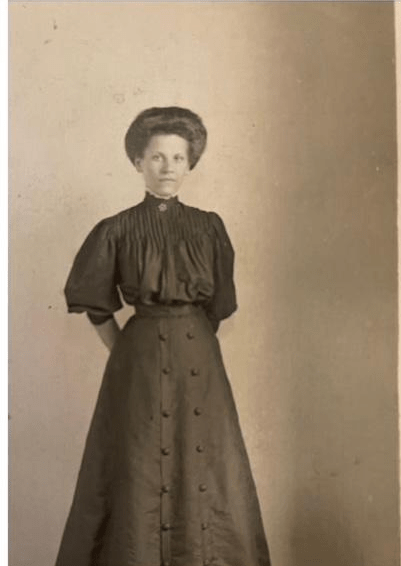
In the attic, I found a collection of antique stereoscope cards. I saved the collection from the dumpster and took it home. Among the cards was a photograph. It is a photo of a woman, dressed in a per-World War I fashion.
Searching for her identity led me to the story of the modern cardboard box, and its conceptual design, which begins in Amsterdam, New York. I discovered that this woman (Jessie Warner) is a daughter of John Warner.
John Warner was the President of the American Box Machine Company (ABMC) in Amsterdam. This public Company was incorporated in 1885. John Warner was President, Horace Inman was manager, Arthur De Forest was Treasurer, and Bernard Finlayson was Secretary. In 1885, the cardboard box was cutting-edge technology. Everything before then had to be shipped by the barrel, crate, or in a bottle. The invention of the cardboard box led to a significant decline in shipping costs, and the person who held the patent on this machine stood to make a fortune.
John Warner, who arrived from England in 1856 and settled in Amsterdam in 1860, resided on Pearl Street. He married a Scottish woman, Jannette Mitchell. They made an acquaintance with a close neighbor, Arthur De Forest. Warner and DeForest had their own knitting mill. Warner, from England with a Scottish wife, made their acquaintance with another Scotsman, Robert Gair, who held the patent rights for the box machine.
Of course, there’s a world of difference between conceptual engineering and practical engineering. The practical engineer was Horus Inman. Horus was a self-made man; his parents died young, and he was raised by relatives in Hagaman. He taught himself engineering.
What Warner and Inman needed was a nice, quiet place to build their prototype. The road from Hagaman to Amsterdam took Inman down by the old Clizbe farm in sparsely populated Rock Town, past the old flower mill. Inman and Warner built their prototype in the old flower mill in Rock City, now located at 2 Hewitt Street, Rockton, Y. The prototype of the first modern cardboard-making machine in America was made in this place. We know it today as the Creekside restaurant and brewpub.
This was going to be a significant industry in Amsterdam, New York, but then everything seemed to go wrong. March 30, 1890. Benjamin Finlayson dies of diabetes, the son-in-law and close friend of DeForest. Finlayson was only 33 years old and left behind a wife and children, as well as being the secretary of the American Box Machine Company. In 1895, John Warner died in Route from Europe to America, dying aboard a steamer due to a heart attack.
In 1896. A fire at the building known as “John Warner’s Sons’ property (Creekside Tavern). That year, Horace Inman was arrested several times for smashing counterfeit box machines in Canajoharie,
And all the time, the lawsuits kept coming. The largest one resulted in the Company losing $10,000.
“John Warner’s Sons’ (Creekside) was declared bankrupt January 19, 1903. And sold to Louis Harrower at auction. Harriet Warner, who still lived at Clizbe Ave., filed her own personal papers at that time, separating her from the Company and thereby saving her home, Clizbe Ave., from foreclosure.
December 19, 1904, the application was made for the dissolution of the(A B M C), and on December 17, 1904, the corporation no longer exists.
I have found one postscript: more evidence to my lady in the photograph in the attic, a picture of John Warner Junior in a World War I uniform. Listing his place of residence as Clizbe. His employment is listed as Harrower Mill, 2 Hewitt St., and his job is listed as a box maker.
Discover more from Site Title
Subscribe to get the latest posts sent to your email.
