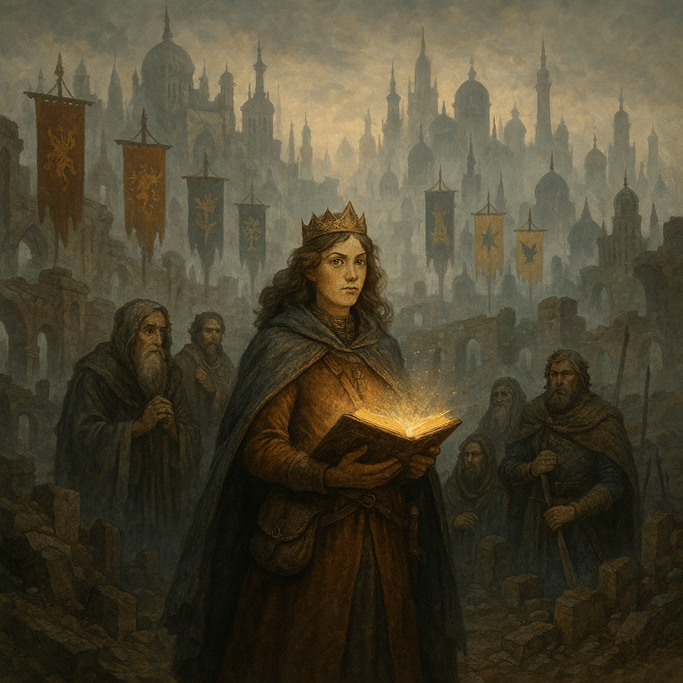
They had sworn an oath, the protectors, an alliance forged not from trust but necessity—to guard the princess, who was now Empress of the Warrasua. She would travel by proxy and by fate alone; her future settled by signatures, her name now Argonne. She was only fourteen, Princess of the First League, selected for a distant Emperor as the last desperate offering to peace. “The Confederation of the Three Leagues” was once vibrant, full of energy and rivalries and life, but the great war broke it into fragments. Millennia of fighting meant a century of devastation. Millions dead; the plague that arrived after the slaughter gnawed on the skeleton of hope, left in the eleven empires. All that remained was unity—but unity in name only, pieced together with treaties and arranged marriages and brittle words, nothing like what came before.
The journey itself was ritual as much as passage—a procession across darkening waters, carrying with them the future. Argonne’s retinue: Arcturus, first among her companions, and a solemn guard numbering twenty-seven. Their purpose, explicit and sacred, was to accompany the royal girl to her distant, unknown sovereign and the awaiting court.
On deck, days and nights passed in salt-silvered cycles. What gave Argonne comfort, or at least distraction, was her gathering of stories. She collected fables, seemingly naive and harmless, plucked from the memories of her shattered league like small, pale feathers from some extinct bird. Yet with each new tale, she began to sense the depth beneath the surface—a sediment of secrets, causeways of memory, each myth carrying more torque than anyone could have believed. The innocent-seeming narrative, once deciphered, would change everything.
The first and longest stretch of the journey was always the sea, and so it was now: Argonne and her retinue adrift on tide and treaty, bearing the collective future of their people toward the unknown. The ocean, in this latitude, was not temperate blue but a roiling slate, each passing hour bringing a heavier ceiling of cloud to press them downward, until the very act of breathing seemed an affront to the weight of the world. The water carried not only their ironclad vessel, but also the ache of all who had sailed before—armadas and refugees, the grand flotillas of empire, and the hollow-eyed survivors of the last Confederation war, exiled to the margins of memory. The brine was inescapable; it clung to skin, marinated every cloth and hair, and left tongues swollen with an unquenchable thirst. There was a myth, Arcturus told her, that the sea was simply the mouth of some ancient and patient beast, and all rivers were the routes it used to taste the world. To Argonne, the sound of the waves lapping the hull became the low, reverential chant of that monster—waiting, always, for the next mouthful.
The ship was a relic, its bulk imported from a dynasty so ancient its makers were a rumor. Even so, the vessel had been retrofitted for this singular voyage: every hold and cabin sealed, every deck reinforced, every window replaced with shatterproof glass. The crew, like the ship itself, seemed assembled from mismatched centuries. Old men who still believed in ghosts and omens. Young women who slipped between languages with the agility of cats. Hungry orphans, indentured for the promise of a meal at journey’s end. The captain, a woman called Mraz, wore a coat braided with medals from every empire, but she trusted only the compass she kept chained to her throat. This was the company that ferried the future Empress of Warrasua, each member sworn to secrecy and survival, their loyalty as brittle as the salt caking their boots.
But the ship’s true cargo, and the reason for all this ritual and vigilance, was Argonne herself. She spent most days in her cabin, confined not by decree but by the gravity of her own thoughts. The space was sparse: a cot, a desk bolted to the floor, a single trunk containing letters of state and the ceremonial garb she would wear upon her arrival. Arcturus alone was permitted to join her for meals, though most days the two sat in pointed silence, the air thick with unspoken fear. At night, after the lamps were doused and the decks patrolled by the silent honor guard, Argonne would rise and pace the length of her quarters, reciting the stories she had gathered, her voice a hushed counterpoint to the restless sea.
She had begun this habit as a child, back when stories were simply stories and not the currency of survival. Her mother, a Queen of the First League, taught her that every myth was an encrypted map—each fable a vector in the greater geometry of power. Now, with every recitation, Argonne sifted for patterns, for molecules of meaning that might be recombined into the formula for her own fate. She was not naive: she knew that history was a ledger, and that her name, newly minted, was already being balanced against the debts of a thousand ancestors.
On the thirteenth day, the lookout announced the first sighting of Skyborn, the port city that marked the edge of the Classbe Empire. At first it was only a rumor on the horizon, a distortion in the air, then a finger of smoke, and finally the silhouette of towers like ribs prying open the sky. The anticipation on deck was palpable, the guards assembling in their finest livery, their faces composed yet tight. Arcturus brought her news of the city’s approach, and for the first time in weeks, Argonne found herself drawing a full breath.
Yet with every mile nearer to Skyborn, the air grew heavier. Stories abounded of the city’s cruelty: how the Classbe lords preserved their own dead in crystal and displayed them as warnings; how no foreigner had ever left its gates unchanged, and most never left at all. The city’s walls were rumored to be laced with the bones of conquered peoples, and its libraries were said to contain not books but the preserved tongues of traitors, catalogued by dialect and infraction. Even the sea recoiled as they drew close, the surf churning with a violence that seemed personal.
The guards conferred in whispers, their formation shifting to cover every approach, as if they expected an assault from the very air. Mraz, the captain, summoned Argonne to the bridge for the formal briefing. There, she explained the approach protocol: they would sail under a flag of truce, fire no cannon, and transmit their cargo manifest to the city’s harbormaster in perfect transparency. Any deviation would trigger a response from the skyward batteries, which could sink a fleet in one volley. Argonne listened, nodding at every clause, her mind already mapping the routes of escape, the tones of deference she might employ, the way each word would weigh against the scales of suspicion.
When the city finally enveloped them, the effect was total. The sound of the sea was replaced by the clangor of iron bells, the caw of engineered carrion birds, the ceaseless grind of gears and pulleys that moved the city’s great bridges. Porters swarmed the docks, faces masked in the livery of their syndicates. The docking itself was an ordeal: first the ship was boarded by inspectors in mirrored helmets, who sniffed every crate and scanned every document, then the passengers were led single-file onto the wharf, each one branded with an invisible mark that would track them through the city’s labyrinthine streets.
Argonne walked at the center of her procession, every eye upon her. She wore the ceremonial white of the First League, the fabric so fine it seemed spun from cloud. At her side, Arcturus looked less like a companion and more like a sentinel, his hand never far from the hilt of his blade. The walk from the dock to the Embassy was less than a mile, but it took hours, each intersection guarded by checkpoints and crowds of onlookers. Some jeered, others stared with blank, predatory curiosity. Argonne kept her gaze ahead, replaying the fables in her mind like a shield.
The embassy was a fortress of glass and stone, staffed by a skeleton crew of loyalists from the old Confederation. Here, at last, the retinue could rest. The guards were billeted in a barracks carved into the embassy’s basement, and Arcturus disappeared to confer with the city’s intelligence contacts. Argonne was escorted to the diplomatic suite—a room that smelled of wax and old paper, its windows shuttered tight against the possibility of listening devices. The only decoration was a mural depicting the founding of Skyborn: a thousand faceless figures kneeling before a single, red-caped ruler.
Alone for the first time since their arrival, Argonne allowed herself a moment to collapse. She lay back on the stiff embassy bed and stared at the mural, tracing the arc of each kneeling supplicant with her eyes. Somewhere in the city, the Emperor awaited her, ready to claim the prize that was her life and name. She wondered if he knew the stories she carried, if any of them would matter, or if she was merely another offering to the maw of empire.
Yet even here, marooned on the far side of history, she felt the old compulsion: to gather, to catalogue, to retell. She rose from the bed, found a scrap of paper and a pen, and began to write the story of her own arrival—not as a victim or a pawn, but as the last, defiant archivist of the First League. It would be a small thing, likely destroyed or forgotten, but she would leave it nonetheless, a fable embedded in the bone of this place.
“You can only go forward by knowing where you came from.” The words echoed, ballast against the ocean’s rolling uncertainty. Argonne drew from the past at every turn, gathering fables from the first league and committing them to mind with careful diligence. With Arcturus and the other companions, the fables multiplied. In the gentle hush of her quarters, she whispered them aloud, fingers tracing sigils in the air as if each story could steer her ship or her heart toward safety.
Stories had always clung to her, tenacious as the salt in the seams of her cloak and persistent as the tides that battered the hull. They did not only follow Argonne, they defined her. Every fable—a fragment of myth or memory, gleaned from the old halls or whispered in sickrooms back home, now bundled tightly for the journey—not only promised survival but created its own strange gravity, pulling at her with a weight that could not be ignored. The Confederation, gaunt with war and parched by plague, fastened its last longing for peace on the slim promise of a child’s untested oath, and upon those thin-walled vessels of understanding that legend alone could shape. Argonne herself, just fourteen, crossed the Great Sea with twenty-seven companions. Her only inheritance: stories, hoarded and sealed against cold or doubt, her future interleaved entirely with scrapings from the past, myth, and the brittle hope that some hidden lesson within might prevent disaster.
Initially, the Princess did not speak. Nothing at all. Their party departed in silence from Ammerall’s citadel, leaving behind the unmoving gray of the stone towers, the hush of emptied corridors, the cold that filled a place when its voices faded out for good. She retreated to her cabin, almost vanishing inside herself, a breathless hush more than a presence. Everything about her—the stillness, the way she folded her limbs as if to vanish into air, the squared jaw when spoken to but never answering—made it clear she was not ready to let go. Not her homeland, not the friends knotted around her childhood, not the echo of steps she once matched stride for stride along castle galleries. Only duty, fraying but unbroken, bound her to the voyage. Sometimes she dreamed, but only in fragments: the freedom to choose, not simply the unyielding cloak of responsibility, so heavy it smothered every other wish. That was gone now, replaced by the endless ship’s beat and the relentless ocean, carrying her toward a future determined not by her but for her. Her fate: to marry a stranger, serve a cause she could not decipher, and deliver herself to a people condemned as savage, feared as cannibals. She was told it would bring peace, though the logic of that sacrifice eluded her. Resolute and isolated, the Princess endured, and her stories endured with her, as if between them they might anchor her to a version of herself she could still claim.
Discover more from Site Title
Subscribe to get the latest posts sent to your email.
