E. Michael Bablin
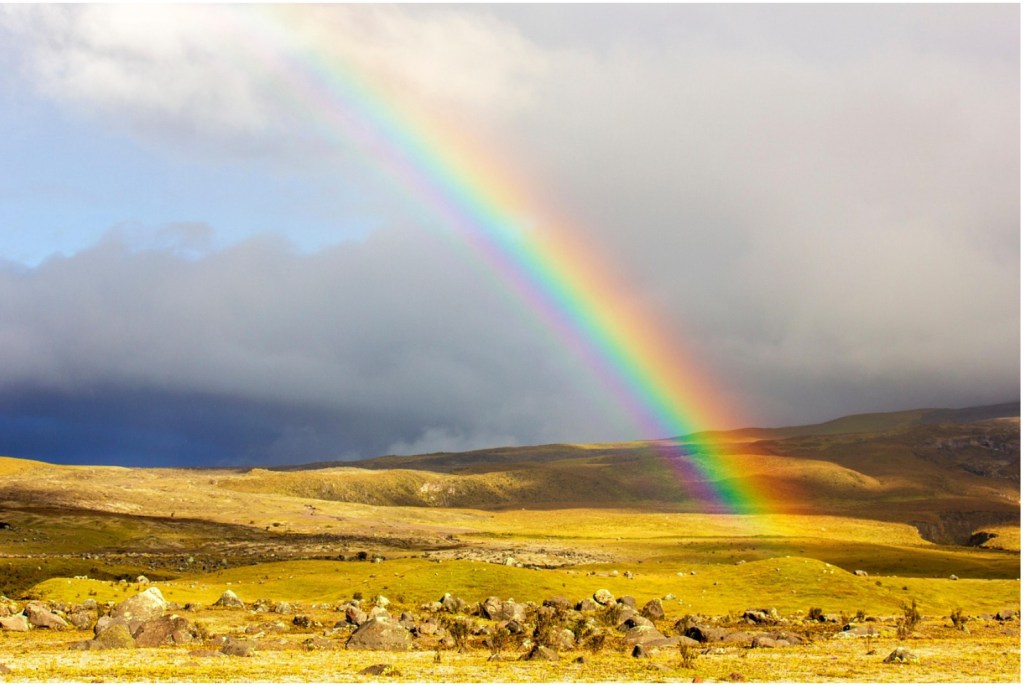
We’re halfway home and I can’t stop watching the rainbow in the rearview. It’s all I want to look at, even though I’m the one driving and Bro is in the passenger seat scrolling through his phone, reading out loud some TikTok drama and then lapsing into silence so the car fills up with more of the soft jazz that he never admits he likes. But the rainbow—hell, it’s a monster, a cartoon of itself, it’s this mucilaginous, absolute band of color, the kind that only happens in bad tattoos or the covers of physics textbooks. There’s still a little rain spitting so the road is wet, glistening with an oil slick shimmer, and the rainbow is reflected everywhere—on windshields, on the lake glass, even in the droplets that hang on the edges of the wiper blades. It’s a whole dome, a bubble big enough to hold the entire town, and all the colors are so stupidly bright and distinct that there’s no point trying to name them. It’s the rainbow and I know it’s for me, like the way a good omen can follow you home, and I keep thinking about how it will look from our driveway, whether it’ll hang over the roof or dissolve before we pull in.
We pass the overpass, concrete still dark with rain, and the rainbow dips down low, cutting through the haze that’s left once the sky clears. For a second the rainbow gets wrung out and pale, then it comes back even harder, like it’s been plugged in and someone cranked the saturation. I flick the wipers again and Bro glances up, sees where I’m looking, and says, “Bro, that’s the gayest rainbow I’ve ever seen,” which is the sort of thing he says when he means it’s beautiful and he wants it too but pretending not to care is his whole deal. I don’t answer, just squint through the windshield and try to memorize the curve of the arc. It’s all I need—this sense that the rainbow exists even when I’m not looking, that it waits for me, sits there like a badge or a signpost or the simplest promise that something can be absolutely true in the world.
The rain lets up almost instantly, just a few spatters along the edge of the glass, and where the rain ends is exactly where the rainbow begins. It’s so sharp it feels like you could drive right up to the edge of it, or maybe like you’re already inside of it, the whole car sealed in by color. I think about contentment and what it means to have something solid that you always come back to, even if it’s just a trick of the light. There’s still so much left to do—school, work, writing, the entire huge haul of days ahead—and I think about how the rainbow will outlast all of it, how it will keep showing up in the same place every time there’s rain and sun at once. I wonder if I’ll ever get tired of it, if at some point I’ll just stop looking up.
But right now the rainbow is the whole show and the street is empty, and we’re close to home and I slow down so I won’t lose the view. I’m already planning how I’ll describe it, which words to use, but none of them will be enough because the rainbow is exactly itself and nothing else, not a metaphor, not a hope, just the world doing its thing and me getting to see it. Even after we’re inside, I know I’ll keep thinking about it, about how it follows me, about how it waits for me each day I come home.
am, right in it, the rainbow as the view It becomes a thing I chase, not just in the childish sense, but as a real orientation, a gravitational slant to my entire day. I’m up before the streetlights blink off, before the heat kicks in, and it’s there—if not in the raw sky, then in some residue on the apartment walls, a prismatic shadow crawling over the eggshell paint as the sun comes up behind the mist. It doesn’t matter that it’s October, that the forecast says only drizzle and fog, because this rainbow is stubborn, engineered out of the angle of my window and the steady damp in the air. Sometimes it’s so faint I have to squint for it, other times it’s enough to make the whole living room look staged, like I’m living in an ad for vitamins or fast internet. The rainbow: always there, always performing, even when there’s no one to watch but me.
October, and it inserts itself into breakfast: in the sweat-condensed beadwork on my mug, the slow drip down the inside of the French press, the way it bands itself—clean and miniature—across the surface tension of the spoon. It overlays everything, not just color but clarity. Rainbows on rainbows, and once, when the clouds finally break for an hour, there’s a double, two identical arcs, perfect as parentheses, framing the bare trees and the crows shouting over the power lines. I can’t help but see it as a bracket around my entire life, a pair of arms drawing a territory just for me. I lean against the counter and stare until my eyes water, thinking: here I am, exactly where I’m supposed to be, mapped by these bands of light.
It’s not that the rainbow is special, I remind myself. This street is like any other, a lazy curb, cracked sidewalk, the early walkers out with their flannel and their dogs. But the rainbow gives it context, and more than that, it feels like it’s making a point out of simple repetition. Every day, in some form, for weeks now—refined and present, a challenge and a comfort at once. It’s not a reward; it’s a constant. I don’t need a diploma or a letter of acceptance. I just need to stand still and let the thing find me. I wish I could tell Bro, or Mom, or someone, but I know it’s better as a secret, something too huge and dumb to explain in a text.
I try to write about it. I open the Notes app and type three lines, delete them, start again. There’s no way to get it across—the way the rainbow shifts from a visual to a presence, something that hovers and presses, that tints every other thought I have. I remember reading about how a rainbow isn’t real, how it’s just a direction, a condition of the eye and the rain and the angle of the sun. It only exists because you look for it, and if you move, it moves; if you blink, it’s gone. I write that down and let it sit, watching the light crawl up my hand, the way the veins and tendons get painted in impossible color, like I’m being made and unmade in the same moment.
I’m not in love with the rainbow—don’t get me wrong. It’s not a metaphor for anything, not some sign from the universe. But it’s there when I wake up, it’s there when I pedal the bike to campus, it’s there in the puddles and oil slicks, in the smeared rear window of the bus, in the condensation on every bathroom mirror. It’s an epidemic, a viral persistence, and I think maybe that’s what I need right now: not a goal, but a structure, something visible and predictable when everything else is so shifty and made of air.
The dome of it is what I keep coming back to. Not just a stripe, but a whole hemisphere, a planetarium shell projected over the world. I imagine what it would be like if you could walk along the inside of the arc, hands pressed to the wet glass, feeling the spectrum wash you clean every way you turn. I think about explaining it to Dr. R from physics last semester, how he would go off about optical density and refraction, about how the rainbow is never in the same place twice, how everyone gets their own private version. That feels good, somehow—like this is not just my rainbow, but one that’s built for every person dumb enough to get up early and look for it.
Some days it’s so bright I start to laugh, like it’s trying to get a rise out of me. Once, the rainbow gets into the living room before I do, and I catch sight of it on my way down the hall: a full color wheel turning across the flat of the floor, leaking through the cheap blinds in a patchwork that lights up the dust in the air. I step into it and stand there, waiting for something to happen. The air smells like wet brick and burnt toast, and for a second the only thing moving is the rainbow, crawling across the room as the sun shifts behind the clouds. I could stand in this light forever, but Bro yells from his room to tell me I’m going to be late, and the spell breaks. I shuffle out, but the rainbow comes with me, splintering off the hallway mirror, curling around the banister, fractaling into the day.
I’m obsessed enough to track it, checking the hourly weather, plotting the angles, noting little differences—today the blue is wider, yesterday the red was bleeding into the orange. I start to take pictures, but the phone camera never gets it right, always flattening the color, making it look like a sticker slapped on the sky. I have to give up on the idea of sharing it, because even when Bro looks up from his phone and squints out the window, he just shrugs and says, “That’s cool, I guess.” No one else seems to care, and that makes it better. I let the rainbow have its little life as my own.
But sometimes, late at night, I replay the day and wonder what happens if the rainbow stops showing up. If a week passes with nothing but flat gray and the windows stay dry, will I be able to stand the absence? Will I default back to the person I was before, filling every blank moment with noise or food or the next half-baked project? I try to picture the room without the bands of color, the streets without the oil slick shimmer, and it feels small, a little suffocating. I decide not to think about it. I tell myself there will always be rain and always be sun, and as long as I wake up early and keep an eye out, there’s a chance the rainbow will be waiting.
I remember a time when I was little, maybe six or seven, and Mom took me to the science museum. There was a glass tunnel, and if you walked through at the right time of day, they’d filled it with artificial mist and project a fake rainbow along the curve. Every kid would run through, trying to catch the end of it, but the rainbow always stayed a step ahead, always out of reach. The guide told us it was impossible to touch, that you could never stand at the end of a rainbow, because you carried it with you everywhere you went. I didn’t buy it then, but now it makes sense. The rainbow is a chase, a moving target, but it’s also the reward: you just have to keep walking, keep looking up, and it’ll come find you.
I think about the double rainbow, how it marks out a kind of border, and I wonder if there’s a word for that feeling: not arrival, not belonging, but a sense of having been selected by the universe to witness something stupid and beautiful, even if it doesn’t last more than a few seconds. The rainbow doesn’t care if anyone is watching, but it still makes a show of it, strutting across the sky like a dare. I want to learn how to do that, how to exist just for myself, bright and untouchable and absolutely present.
I make it a ritual. Every morning, I look for the rainbow first thing, before I brush my teeth or check my phone, before I do anything else that matters or doesn’t. Sometimes it’s there, sometimes not. On the days it’s missing, I notice the lack, but I don’t panic. I know it’ll come back, because rain is always in the forecast, and autumn is just getting started. The rainbow is my check-in, my confirmation that the world still works, that the rules of light and water haven’t changed overnight. Most days, that’s enough.
I can feel the rainbow even when I don’t see it—the way it lines up my thoughts, gives order to the mess of my head. I try to think of other things, classes or Bro’s drama or what I’m going to do after graduation, but the rainbow always elbows back in, demanding its due. It’s become a part of the architecture, a fixture like the squeaky door or the noisy fridge, but so much more precise. The rainbow is always in the same place, at the same time, but never exactly identical. There’s a lesson in that, maybe, but I’m not ready to spell it out.
I tell myself it’s only a trick of the light, but it feels like more. A presence. A guarantee that when I look up, something will answer back. I like how that sounds, even if it’s just a lie I repeat until it’s true. I wonder if other people
every time I move, always there whether I’m brushing my teeth or microwaving leftovers or just standing there, looking, not even pretending to do anything else. In the kitchen, the rainbow runs a stripe along the wall above the toaster, bends itself to fit the corner of the cabinet, flickers off the dull white of the fridge. At breakfast I watch it halo the rim of my coffee mug, see it flicker in the spoon before I stir in the sugar. There’s something about the way it multiplies—first one, then a double, sometimes more if the angle’s right—and suddenly it’s rainbows all the way down, each one stacked on top of the last, never quite in the same place as before, but always nested together, repeating the arc and the color and the idea of it until you can’t find the edge of where it starts.
Sometimes I feel like the rainbow is a message, not from God or the universe or even the weather, but from the day itself, like every morning it’s trying to tell me what the day is going to be, or at least what it already is. Sometimes it means I should try harder, sometimes it means I should let myself go, sometimes it means I should keep my mouth shut and just be glad the rainbow is still here. It follows me back to my room, the colors stretched out and warped across all the posters and the cracked ceiling, a prism that never lines up with itself but never goes away, either. I think about that: how some people grow up with banners or medals or team colors, but for me the only flag I ever saw hanging in my room was the rainbow that showed up in October and sometimes lasted till December if the weather was right. It’s always there with me, not as a label or an answer or even a comfort, really, but as a dare. Like, can you be as obvious as this? Can you be as complete and ridiculous and unmissable as this? Can you be as honest as a rainbow, which is to say, can you be a thing that only exists because of every other thing happening just the way it does, can you be content with being the result of someone else’s light passing through you?
Even when I try to leave it behind, the rainbow comes with me, stuck in the oil slick on the sidewalk, in the glare off parked cars, in the flash of CDs stacked in the thrift store window. It’s inescapable, not just for me but for everyone who happens to look up at the right minute. I try to take pictures but they never work—the rainbow is always too bright or too washed out, too much for the phone to handle, too much for me to catch in a way that doesn’t flatten it out or turn it into something it isn’t. So I keep it for myself: the rainbow as memory, the rainbow as anchor, the rainbow as the reason I get up in the morning and the reason I can still come home after a day of being something less than the whole spectrum I’m supposed to be. I keep waiting for it to go away, for the sky to forget how to make it, but every time the rain lifts and the sun comes back, there it is, a little more faded or a little more intense, but always there, a signpost or a checkpoint or even just a joke the universe keeps playing on me, day after day, year after year.
I can’t decide if the rainbow is something I’m supposed to live up to or something I’m supposed to just live with. Maybe both? Either way, it’s always here; it isn’t something I graduated into or earned with a diploma or a clever essay, it’s just a fact, a condition, a challenge that can’t be shirked or failed or passed off on someone else. It marks out the space where I’m allowed to exist, the patch of the world that no one else can take from me, the bubble that holds all of my best and worst selves and tells me, here, this is yours, you don’t have to be anything else. The rainbow is not only for me, but it is of me, and that’s what matters: Rainbow is me.
Walking on the sidewalk beautiful fall day no clouds orange trees red trees leaves are falling happy and sad at the same time next year‘s smells of apple pie and baseball coming home for McLeron school to watch the World Series I am i 60 years old in 2022, or I’m I 10 years old 1972 I can’t seem to figure it out
The sidewalk was a strip of gray static running through the riot of the neighborhood’s color, and I followed it like a pulse line, trying not to step on any of the cracks because I still half believed the old rhyme about broken backs. The sun was out, warming my ears and the bridge of my nose, but the air was sharp—one of those perfect fall days, no clouds, just a blue so clear it felt like a dare. My feet shuffled through the ankle-high drift of leaves that had piled up along the curb, and each step set off a new crackle, sharp and brittle and loud, the sound of endings and beginnings all at once. I couldn’t decide if the trees were orange or red or just on fire, so I settled for all of the above, letting the colors burn through my eyes until I could smell them, the singe of crushed maple and the near-rotten sweetness rising from the grass where the leaves got wet and clumped together.
There was a weird ache in my chest, the kind you get when you realize you’re exactly where you want to be and also afraid you’ll never be able to stay there. The world felt smaller in the fall, like the sky and the ground were squeezing together to keep me in place, but it also felt infinite, because with every breath something new was happening—a gust of wind, a squirrel breaking cover, a neighbor shouting down the block, the sure rhythm of the day rolling on whether or not I wanted to move with it. Every sense was full. The taste of cold in my mouth, the echo of distant laughter, the sugar-and-cinnamon smell of pie from someone’s open window. I could almost see the years stacking up around me, layer after layer, the memory of every other walk home crowding into this one moment until I wasn’t sure if I was ten or sixty or both, stuck in a loop where nothing changed and everything did.
Ahead, the sidewalk turned and the air changed with it, the wind carrying the faraway scent of something scorched—maybe a backyard fire pit, maybe someone burning dinner—and underneath that, a dark, earthy note that was pure October. The leaves made a new pattern on the ground with every hour, and I watched the shadows flicker over my shoes, watched my own shadow shrink and stretch with every step, never quite matching the way I thought I looked. My backpack felt heavier than usual, even though I’d forgotten most of my books at school, and my hands kept drifting to the zipper to make sure it was still closed, that nothing important was falling out as I went. That was the other thing about fall: it was always a season of almost-lost things, of remembering too late or just in time, of holding on a little tighter because you could feel the days getting shorter, the sun setting a few minutes earlier every afternoon.
I didn’t know what I was supposed to feel—proud, like I’d made it to the next grade; nervous, because I was already behind in two classes; sad, because the year was almost over and I hadn’t done any of the things I’d promised myself I would; or happy, because this was my favorite time of year and the entire block seemed to know it, seemed to dress itself up just for my benefit. Mostly I felt tangled, like the present and the past were walking side by side, each one daring the other to sprint ahead and leave me in the dust. Somewhere between the sound of the leaves and the distant crack of a bat on a baseball field, I remembered that it was almost time for the World Series, and that meant nights on the couch with Dad, microwave popcorn, the glow of the TV painting the room in sudden blue light during every commercial break. That was the anchor, the thing that pulled all the years together—coming home in October, finding the house just warm enough inside, hearing the game on before I even got through the door.
I tried to hold onto that, to the feeling of coming home at the exact right moment, but the years wobbled in my head and I couldn’t quite pin down which one I was in. Was I the kid, sprinting the last stretch because the sun was already down and I was supposed to be home before dark, or was I the grown-up, walking slow on purpose, dragging my feet through the leaf piles because I didn’t have anywhere else to be? Maybe both. Maybe neither. I kept walking, kept breathing in the gold and red of the trees, kept waiting for the sidewalk to tell me where I belonged.
It was a strange kind of nostalgia, equal parts sweet and bitter, as if the very air was trying to remind me that every good thing has an expiration date. Each step I took on the sidewalk, I could feel the weight of every other step layered underneath it, a geology of footsteps that belonged to every version of myself that had ever walked this block—five years old, clutching my mother’s hand and skipping to match her long strides; ten and reckless, jumping the cracks with knees already stinging from yesterday’s crash; fifteen, slouching and scowling and pretending not to care that no one would walk beside me anymore. The sidewalk remembered all of it, and sometimes I thought the cracks were just the way it kept track of the years, a kind of secret calendar written in concrete and neglect.
The air that day was thick with reminders, each one as sharp as the chill on my bare arms. The sound of my sneakers scuffing over the leaves brought back the hollow percussion of a baseball in a mitt, the late-afternoon pop of a distant bat, and the echoing calls of kids who never seemed to get tired. At first I tried to walk fast, to outrun the feeling that I was somehow falling behind, but the faster I went, the more the memories stacked up—here was the house where I’d broken a window with a foul ball, and the scuffed spot on the curb where I’d first kissed someone whose name I can’t remember now. There was the mailbox that caught my backpack every Tuesday without fail, the metal bent from years of dumb accidents. None of it had changed, and all of it had.
But there was something new, too—a quality to the light I swear wasn’t there when I was a kid, the sunlight slanting sideways across the porches and lawns, so gold it looked too rich to be real. Maybe it was just the way my eyes worked now, or maybe the world really did get more beautiful the closer it got to ending. I noticed things I never used to: the way the leaves not only burned orange and red, but also curled in on themselves as they dried, little fists closing around the season’s last secrets. The way the air tasted sharper at dusk, like breathing in a promise that could only be kept if you stayed quiet and listened. The ache in my knees, subtle at first, then growing louder with every block, a reminder that the body keeps its own record, independent of the mind’s nostalgia.
I found myself counting breaths, counting steps, measuring the distance between the past and the present with whatever tools I had left. I wondered how many more times I’d get to walk this exact stretch before something changed so much that it wasn’t mine anymore. Would I even notice when the neighborhood shifted for good, when the houses and trees and people gave way to something else? Or would the sidewalk just keep holding onto my footprints, waiting for the day I came back and tried to fit myself into the outline I’d left behind?
The intersection was coming up, the one where the sidewalk forked in two directions. Every time I reached this spot, it felt like a decision was being made, even if it was just muscle memory or the pull of routine. One way led straight to my house, warm and yellow-lit and waiting; the other looped around the playground and took the long way home, past the field where the neighborhood kids still sometimes played until it was too dark to see. In my head, the fork was never just about getting home—it was about which self I wanted to be when I got there. The responsible one, the one who finished homework and set the table and answered questions with a yes or no? Or the ghost of the kid who used to rule the playground, who could throw a fastball and climb the monkey bars two at a time and never had to think about the next day, because every day was already full?
The leaves blew up against my ankles, little tornadoes of color that made the world feel in motion even when I stopped moving. Somewhere a lawnmower coughed to life, and the smell of cut grass mixed with the dry, smoky sweetness of burning leaves from down the block. I closed my eyes for a second, and in that dark, I could see October layered on top of every other October I’d ever lived, a stack of years so high it made me dizzy. I remembered the last time I’d watched the World Series with Dad, how he explained the rules in a way that made the game sound like a secret language, how he never yelled at the screen even when the home team blew a lead. I remembered the way the living room always felt different at night, somehow bigger and smaller at the same time, every corner lit up by the TV and every blanket still warm from whoever had been there last. I remembered the terror of being late, of knowing the streetlights were already on and that every house I passed was a witness to my failure to get home on time.
It was like the world was daring me to pick a lane, to decide who I was going to be from now on. But the truth was, I didn’t want to pick. I wanted to stay in the overlap, the blurry part where old and new selves could look at each other and nod in recognition. The sidewalk didn’t care which version of me showed up; it just kept going, steady and indifferent, collecting leaves and shoeprints and the slow accumulation of time.
I hesitated at the fork, suddenly aware of how quiet the neighborhood had become. The sun was almost gone, just a smear of gold behind the roofs, and the cold was starting to bite in a way that promised real winter wasn’t far off. In that moment, I felt the familiar ache of wanting everything and nothing to change at once. I wanted to be the kid who sprinted home, the grown-up who walked slow, the version of myself who would someday bring their own kid here and watch them try to jump every crack without missing a single one. I wanted to remember everything, and I wanted to forget just enough to make the present feel new.
I almost laughed at how dramatic it all felt, like the climax of a book I didn’t remember starting. But maybe that was the point—maybe every day was supposed to feel like a conclusion and a beginning, a chance to look at the same old world with eyes that had seen just enough to know how much could still change. I glanced down the block at the row of houses, each one with its own constellation of porch lights flickering on, and felt a weird gratitude for the sameness of it all. It was like the universe had decided that, just for tonight, everything could stay exactly as it was, no surprises, no disasters, just the slow turning of the seasons and the unremarkable beauty of a street I’d never bothered to name.
I kept walking, letting the sidewalk decide for me, content for once to follow the line instead of breaking from it. The sky had darkened just a little, and the first stars were starting to show, and I realized that no matter how confused I felt, I was exactly where I was supposed to be: on the sidewalk, in October, surrounded by all the colors I could never name, heading home.
For a second it feels like the year could go either way, like I could choose which one to live in, or maybe even both at once.
Discover more from Site Title
Subscribe to get the latest posts sent to your email.
