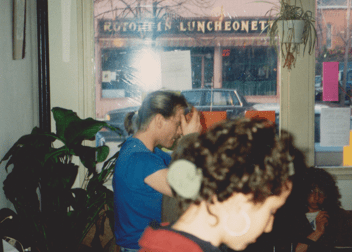
Come back to the five and dime, Arnie Primo, Arnie Primo.
E. Micheal Bablin 1997
Come back to the five and dime, Arnie Primo, Arnie Primo. The streets have changed their names but not their habits; they run parallel, never meeting, the way children in a playground keep to opposite sides and only rarely collide. Come back to the five and dime, which is not a five and dime anymore, but the memory lingers like the penny candy smell that outlasts the store. Arnie Primo, you are not the absence we thought you were. The new owners found your name etched with a key into a green metal shelf in the back, next to where the Dubble Bubble used to be. When the neon light outside finally died, they replaced it with a flicker that never quite gets to “Open” or “Closed,” and that is enough—at the witching hour, that is everything.
Come back to the five and dime, Arnie Primo, Arnie Primo.
You used to cut through the alleys of Troy with a mission and a limp, rain washing the old oil stain off your coat and the rest of us following, bound by nothing more substantial than a shared boredom and a dozen broken bicycles. Crack yourself open at the curb and pour out the night: loose change, sweat, and the sour tang of gin stolen from the church rectory. You wore your thrift-shop waistcoat with the broken Blues, Arnie, hand-sewn in the lining by a woman who lived and died before the first Kennedy was shot. Each button a story, every stain a map to some crisis or revelation. Even at seventeen, you looked like you had turned the corner on life’s big punchline and were waiting for the rest of us to catch up.
Come back to the five and dime, Arnie Primo, Arnie Primo.
Nobody called you by your Christian name except the nuns at Immaculate Heart, but even they surrendered by Lent. To us, you were always Arnie Primo, the first and last of something important, maybe the patron saint of lost causes or just the closest thing we had to a folk hero. You could out-sing the jukebox at Dino’s and out-dance any straight-edge upstart from the cross-town rivalries. You remember the time the fire alarm went off at the after-hours pool hall and you, drunk in your old-man corduroys, shepherded all the strays out the exit, barking orders like a union foreman? We talk about it every December, Arnie, every year you don’t come home.
Come back to the five and dime, Arnie Primo, Arnie Primo.
Your best friend was Hope de Vega Vega, who changed her name twice a season and could shoot pool with both hands. She said her ancestors were Basque, but I think she just liked the look of it in Sharpie on her backpack. Hope de Vega Vega had a laugh that could shatter glass and a mother who worked two jobs and left notes in the fridge, “Hope: Buy milk. Love, Mom.” There are still people who say you and Hope dated, but the truth is you both just needed someone to stand lookout. You swapped poetry and cigs under the old railroad trestle, carved your initials into the crosstie, and on the hottest day of July you stood at the edge of Bumbercar Lake and dared the other to jump first.
Come back to the five and dime, Arnie Primo, Arnie Primo.
By senior year, you had invented at least five new religions, each one more elaborate and less likely than the last. You preached them in the gravel parking lot after football games, conversion rates about equal with the lottery odds. But you knew how to listen, too, and you kept everyone’s worst secrets folded up in a gum wrapper in your back pocket. You looked, looked, looked for water, any kind of water—fountain, puddle, wild lake, even the condensation on the old freezer case at the A&P. You walked the streets of Troy looking for a high city of gold, a skyline worthy of your elaborate mythologies, and when you found it wasn’t there, you created one from abandoned warehouses and the stuttering light of the Sbarro sign reflected in rain.
Come back to the five and dime, Arnie Primo, Arnie Primo.
You always had a theory about the world, Arnie. You said the universe was built from the leftover atoms of failed cigarette brands, that every broken bottle held a secret message from a parallel dimension. You immortalized your spangled universe in copper stone—graffiti murals on the sides of condemned buildings, chalk drawings in the dust of condemned playgrounds, and once, a sculpture of dryer lint and coat hangers in the foyer of the public library. Sometimes you’d pick up cigarette butts big enough to smoke and, with a magician’s flourish, light them with just a spark from your busted watch battery. You shared these with us, the flavor always a little off, a ghost of cherry or menthol, and we inhaled because you said it was good for poetry.
Come back to the five and dime, Arnie Primo, Arnie Primo.
You laughed with your olfactory lungs, Arnie, and if anyone ever understood what that meant, it was Hope. You taught her to ride a ten-speed, patched the tires with duct tape, and when the chain slipped, you told her that was the universe speaking in Morse code. Together you found the only honest pizza in the city, the one place that still used real cheese, and on Fridays when you couldn’t afford a slice, you’d sit outside on the curb and invent your own flavors, describing them so vividly we almost tasted them. You always had a sideways smile, like you were in on a joke about the afterlife, and when you looked at us with those eyes—perpetually rimmed red from allergy or insomnia—we felt, for a minute, that maybe the world was a place you could survive.
Come back to the five and dime, Arnie Primo, Arnie Primo.
But the others, Arnie, the others are all gone now. The old gang drifted, some to college, some to the army, a few to nowhere in particular. Hope de Vega Vega left for Albuquerque with her mother, sent postcards for a while—cryptic messages about cacti and sky, then silence. Dino’s became a vape shop, the pool hall got bulldozed for a strip mall, the railroad trestle rusted out and fell into the river. You more or less disappeared after graduation, rumors abounded—maybe you joined a commune, maybe you got lost in the Adirondacks, maybe you simply morphed into legend.
Come back to the five and dime, Arnie Primo, Arnie Primo.
But here’s the thing: even after years and years, the shine of the old Radio Free America days glows in every retelling. The city never forgets a good story, and you, Arnie Primo, are the protagonist of ours. You, you, you: lost orphan in the storm, patron saint of squandered afternoons, architect of our best mistakes. Come back to the five and dime, Arnie Primo, Arnie Primo. The new owners won’t mind. The old shelf still has your initials, and there’s a cup of coffee sitting by the window, just the way you liked it: black, three sugars, the spoon balanced across the rim in anticipation.
Come back to the five and dime, Arnie Primo, Arnie Primo.
I’m here, Arnie. I’m waiting. And if you walk through that door, I’ll buy the first round of lottery tickets and the last danish on the rack. That’s a promise, as real as anything that ever happened to us.
Discover more from Site Title
Subscribe to get the latest posts sent to your email.
