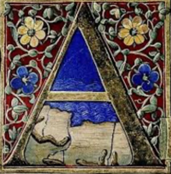
Illuminated manuscripts.

Aldrich the monk, looks out the window of the monastery of Saint Sebastian in the north of England. The snow falls and creates beautiful patterns in the bare brown fields and treeless branches. This monastery makes Illuminated manuscripts to teach an impoverished, very illiterate population the story of Christ and guide them to salvation. But today, he doesn’t feel very excited. Today, he is doing more drudgery and copying another text from an old Pagen Papyrus Scroll. He’d instead copy the Gospel of Saint John like his friends. “I’m stuck doing this Pagan nonsense.” Well, that’s what he calls it under his breath anyway. The temperature drops drastically as the wind picks up, biting at any exposed skin. The tension in the air is palpable, causing hairs to stand on end and goosebumps to appear.

The snowflakes fall gently onto the monk’s face, melting his skin and leaving a chill in their wake. As he walks, the crunch of the snow beneath his feet reminds him of the passing of time and the fragility of life—the coldness of the outside seeps into the monastery despite the warmth of the fire. The monk can feel the chill seeping into his bones, a discomfort that mirrors the unease in his heart.

It was still dark outside, and soon, the sun would come up, although rather meekly, and he would head over to the scriptorium. To finish the Latin text, he’s been working on for the last ten weeks. No one reads it anymore. It’s written in the old Britton Romance language. A language so ancient all have forgotten what it was called, but to those who read and write Latin, it is barely decipherable. Aldrich understands because his mother was a Britton. It has been a good century since the Romans left the island. Still, fewer people even read and write anymore. His mother told him the stories of Roman law and order and civilization. When there was no need to build walls and defend yourself against your neighbor, he thought that was a better time, even though pagans were living about. His mother, a converted Christian, would still gather flowers and put them at the Old Temple of Artemis on the anniversary of his birth, which was the custom for the goddess of fertility and safe childbirth.

The Temple of Artemis was a grand structure of marble and gold, its columns reaching high into the sky, adorned with intricate carvings of goddesses and gods. His mother described the Temple as a grand structure with tall marble columns and intricate carvings decorating its walls. The air around the Temple of Minerva was filled with the scent of burning incense and fresh flowers brought as offerings. The air is heavy with the musty smell of ancient stone and earth. Though the Temple is now in ruins, there is still a lingering hint of incense and offerings from long ago.

 The old bridge school that now stands in its place is a small, plain building made of weathered stone. The monastery is built on this site; the monks took stones from the Temple to fortify their structure and protect them from attack. Eventually, the local lord built a castle wall from its remains. The old bridge school has a musty smell, likely from years of neglect before it was converted into a school. Its faded images of gods and goddesses told stories of old, while its walls showed signs of wear and time. The ruins of the Temple can still be seen, with crumbling pillars and broken sculptures scattered across the grass. The old school was an attempt by the Roman Britton’s to carry on some education and knowledge for at least a little while before the wars created a wasteland. The monastery was built to safeguard what knowledge they had left.

This is where they taught, where the foundations of knowledge and wisdom were kept alive for centuries. The hallowed halls echoed with the laughter and eager voices of students hungry for learning. The walls whispered stories of countless minds that had passed through, leaving their mark on this sanctuary of education.

Now, the school is gone, and the ancient temples are gone. The stones are used to build churches and castles for defense. The world has fallen into chaos. The horizon was always full of activity, with guards scanning the seas for the tell-tale sails of Viking ships and soldiers stationed along the southern border, ready to defend against any threat from the south. The landscape was dotted with lookout towers and fortifications, a constant reminder of the ever-present danger. The guard can see the vast, barren landscape stretching out atop the monastery walls in all directions. The horizon is dotted with ships, their silhouettes cutting through the water as they approach the coast. Beyond the shore, tents and banners of different Norse tribes can be seen, their presence ominous and threatening.

The horizon is dotted with dark shapes and longboats manned by fierce warriors with braided hair and snarling faces. They are the Vikings, bent on pillaging and conquest. Closer to home, armored men on horseback ride along the borders, their shields bearing the crests of Saxon and Angle lords. If you’re not looking out for the Vikings, you’re watching out for the Saxons, the Celtics of the West. Despite being converted to Christianity, most of the people still fight to survive.

Aldrich does not concern himself with the outside world anymore. He knows his task and has accepted it. He is to write down and copy. These texts. To save them from further destruction. “He doesn’t know anyone who reads except those monks in the monastery; even the lords’ children are taught to wield a sword before being taught to read. “What’s it all worth?” He says to himself, “What is all this information for? Will it do any good in the future?”

What Aldrich couldn’t possibly have known is that this copy of the “Meditations of Marcus Aurelius” is, in fact, the last copy in the world; the 700-year-old Papyrus scroll disintegrates as he is reading it to copy on the Parchment of the Illuminated manuscript. He and his fellow monks will be responsible for saving countless ancient texts that otherwise would be lost to time.
— Christmas Eve delivery—


In 1983, Christmas was on a Saturday. On that day, a letter was delivered to a young boy. The night’s weather varied: sometimes it rained, sometimes it snowed, and other times it was bitterly cold. But amidst the darkness, there was still the light and hope of Jesus Christ’s birth, the world’s savior.
This Christmas Eve, Micheal Banister received a gift he still needs to open. He recalled leaving school three days before Christmas and his English professor apologizing repeatedly on the last day of class, telling him she was sorry. he didn’t understand what she was sorry for.
A large family always creates a lot of drama, especially during the holidays. Eight children will join us for Christmas this year, and one sister is pregnant while another won’t make it home. Michael’s older brother was busy renovating a house in Johnstown while his younger brother was finishing his first semester on another campus.

Michael, a 21-year-old college student with brown hair and a constant furrow between his eyebrows, had just received the dreaded letter from the school. It was Christmas Eve, and he had been working two jobs to get through College, but it seemed like it wasn’t enough.
As he quickly snatched the letter from the mailbox, his heart dropped. It was a letter from his College, which he would not open. His grades had been slipping, and he needed help to keep up with his classes. But he had hoped that this semester would be different. He had worked harder than ever, pulling all-nighters and sacrificing social events to study.
But it wasn’t enough. The unopened letter will confirm his worst fears: he had been academically dismissed. He knew this would happen, and the thought of telling his parents filled him with dread.
He shoved the letter in his pocket, hoping no one would notice it. He couldn’t bear facing his family’s disappointment and judgment. There was already enough drama at home, with his sister’s pregnancy and another sister unable to get home to distract everyone.
But as he sat at the dinner table that night, pretending everything was fine, the weight of the letter pulled at him, threatening to burst out and reveal his failure. Michael couldn’t think of anything as his mother went around the table, asking everyone what they were grateful for. He was too consumed with shame and regret. He wished he could pretend it never happened.
But deep down, he knew he couldn’t keep this a secret forever. Eventually, he would have to face the consequences of his actions. And for now, all he could do was try to enjoy this last Christmas with his family before they found out the truth.
The catchy jingles and upbeat music used in radio advertisements added a fun and lively tone to the intro to the advertising class. The sounds of laughter and discussions with classmates during breaks kept him optimistic for the future.
Despite his enthusiasm and enjoyment of the courses, he needed help with his grades. Due to his learning disability, the material was too complex for him to grasp, and he ended up receiving a D in all his classes.
This blew his confidence, and he felt like a failure. He had worked hard to support himself by maintaining an apartment and two jobs while providing for his car expenses. But despite all this responsibility, he couldn’t achieve academic success due to his disability.
As he tried to cope with these setbacks, he found solace in attending parties and socializing with friends. He kept a close circle of friends he regularly visited, often being the center of attention with his charismatic personality. However, little did he know that this attention was not for the right reasons.
His friends partied too much and often persuaded him to join them. Initially, he refused as he didn’t want to jeopardize his future, but after receiving constant pressure, he eventually gave in.
Before he knew it, his life started spiraling out of control. He stopped attending classes regularly, lost his job, and even got into trouble with the law. All this took a toll on his mental health, and he started struggling with depression and anxiety.
He stumbled through school, an outcast without a cause. Bullied and ridiculed, he couldn’t understand why he couldn’t keep up with his peers. All he knew was that he couldn’t grasp the numbers and letters on the page, no matter how hard he tried. His teachers, frustrated with his lack of progress, apologized for their shortcomings and not his. His parents, too preoccupied with their struggles, never noticed the signs of his learning disability.
He was left to figure it out alone, trudging each day with a sense of hopelessness. But deep down, he knew there was something more to his struggles. He could see the world differently, in colors and shapes that others couldn’t comprehend. His mind was a labyrinth of thoughts and ideas, constantly turning and churning. And yet, he couldn’t make sense of the simplest things.
So he retreated into himself, finding solace in books and nature. He became an observer, watching the world pass by, wondering if he would ever see his place in it. But despite the constant challenges, he couldn’t help but feel a spark of hope within him, a flicker of something greater waiting to be discovered.
Little did he know, his struggles were just the beginning of a journey leading him to unexpected places and a deeper understanding of himself and the world around him.
That Christmas Eve was a 40° cold and cold rain feeling. “Where is the snow,” he said to himself. “I’d feel better if there was snow”. Snow at Christmas makes the world less depressed outside and sad because when it snows at Christmas, there is a blanket of white on the ground, and it lets the earth get a good rest.
At the dinner table, he threw himself headfirst into the holiday season. Attending every party and event he could find. He was always the life of the party, making everyone laugh with his witty jokes and contagious energy.
As Christmas Eve rolled around, he gathered with his family for a traditional dinner and gift exchange. He couldn’t contain his excitement as he tore through the wrapping paper to reveal the new cassette tape recorder his parents had given him.
Overjoyed, he immediately called up his friends to make plans. On New Year’s Eve, they danced and laughed until midnight, when they popped open champagne bottles while watching fireworks light up the sky. It was a perfect start to the new year.
But as January rolled around and everyone returned to their busy lives, he felt restless again. He organized a video shoot for his band on Long Island Sound.
Michael returned to his apartment in New Paltz at the end of January. Having no college, no money, and no job and apartment to pay for, sitting on his bed and contemplating how to make the world work when he lived far away are the simple things like getting up in the morning and smelling the bakery next door. The Wildflower Café owner next door gave Michael a few more hours washing dishes to make more money, but it wasn’t enough to pay the rent. The College rebate check returned to him for not taking spring classes in 1984 would see him through the worst of the winter months.
At that moment, it hit him like a ton of bricks. The realization that something precious and irreplaceable was missing from his life. Something that he had tried to hold onto with all his might, that he had cherished and loved more than anything else. And now, it was gone forever.
He couldn’t quite put his finger on what it was or when exactly it had slipped through his grasp. But he knew, deep down, that it was something that had once brought him immense joy and meaning. It was something that he had taken for granted, assuming that it would always be there. His earliest memories were of attending McClary Elementary School and Theodore Roosevelt Junior High School. Then, the Wilbur Lynch High School, Post junior college. And then the State University of New York at New Paltz. He had always been attending classes, which was all he knew. And now all that was gone.
But now, in its absence, he felt lost and hollow. He couldn’t even begin to imagine how he would fill the void that had been left behind.
And as he sat there, staring blankly at the space before him, he knew his life would never be the same again. Whatever he had lost took a piece of him with it, leaving him forever changed.
But still, he held onto the fragile hope that one day, somehow, he would find it again. “I will keep attending classes,” he said to himself.” That’s what I’ll do. I’ll keep attending classes. I’ll go to every professor and ask them if I could sit in on the class”. Let’s pretend to keep going to classes because as long as they can, the band he started with his friends is alive. They must never know. No man, no one must ever know”. He said to himself. And until then, he would keep searching, hoping, and loving.
As February 1984 began, he sat at his desk, staring at the letter he had received from the College; he couldn’t help but feel a pang of regret. Regret for all the missed opportunities and things he could have done if he wasn’t constantly battling his own body. But he also felt a sense of gratitude for the lessons he had learned from his failures. With all this, he finally opened the letter and read it aloud.

The actual letter said this.
Parent or guardian of Michael Banaster
“It is with a difficult decision that we regret to inform you that your son Michael Banaster has been academically dismissed from the State University of New York at SUNY New Paltz. Because of his three continuous semesters of academic probation and a GPA of below 1.27, we have no other choice but to refuse his admission into the spring 1984 semester, Effective December 24th. 1983 We are very sorry to come to this decision. Add hope and wish for the best of you for the future. Signed President of The State University of New York at New Paltz.”
The words he read differed from those on the page, but a fellow dyslexic reader will understand.
Micheal’s letter read like this:
“When you have failed, you must try something else,” the letter read. “Failure is more than success because when you’re allowed to learn, analyze, study, and dissect from failure, success is put in a bag and soon forgotten.” It continues, “Failure is forever, and you always learn from it; I thank my pregnant sister and thank my absent sister and brother, the house builder and my brother, the first-semester freshman, and all those who distracted me from the pain and humiliation of the failure so I may study and learn from this wonderful failure to be a better person from its message.”
He had read those words countless times, finding a new meaning in them each time. And now, as he prepared to leave the College and face the unknown, he held onto those words like a lifeline. I hope for a future filled with new beginnings and chances to try again. Academic failure is a good thing, probably the best gift from that Christmas Eve delivery.

The story of Grandpa john (Йонас Баблінскас ) 

Jonas Bablinskas was born in the Vaitkuškis manor near Ukmerge. His father, Peter, was a soldier of the Kossakowskis regiment, and his grandfather was born into slavery (surf) but was free in 1861. His father, Peter, served 25 years in the Russian army. Peter, along with the entire population of young me were forcibly conscripted into the Russian army because of the rebellion of 1861. Peter would of participate in the action known as the Russian-Turkish War of 1879. Because of Peter’s service in the Russian Imperial Army, John (Jonas) is allowed to attend grammar school. Of course, they will only teach him the Russian language and the Cyrillic alphabet; if he wants to learn Lithuanian in the Latin alphabet, he will have to conduct it at home or with his priest in secret, as teaching the Lithuanian language is against the law. So the reason I never found him in Canada is because john signed his name Баблінскас , or (Jonas Gogrihckac)

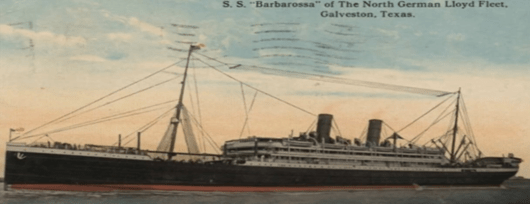
April 9, 1912, in Halifax, Nova Scotia, Canada, the SS Barbarossa is disembarking its 996 steerage passengers. Before it heads to New York Harbor on April 12, it is seven days before the Titanic sets sail. Jonas Bablinskas and his friend Joesph Misinisk wait in line for a final inspection. They are two of five Lithuanians on board at their control station in Galatia, Southern Poland. They received their paper to transit to the Grand Trunk Railway to be laborers. They are contract laborers and have signed a contract to work for the Grand Trunk Railway for five years in exchange for their passage to Canada. They consider themselves the lucky ones. The transit station is in southern Ukraine, near Krakow. So they had to walk about 500 miles South to be one of the people they would pick to be workers. The Canadian Pacific Railroad spread the word throughout the villages and towns of the Russian Empire, inviting Ukrainians to work for them on the railroad. 

  There was a railroad strike, which had been going on since 1906. So the railway president decided to take decisive action to build his road by hiring eastern Europeans, especially Ukrainians, as he was informed, “Ukrainians are hard workers accustomed to conditions on the prairie .”   The President of the Grand Trunk Railway is Charles Melville Hayes. We can only speculate whether he is there to oversee the selection personally. We do know that Hayes was a hands-on manager. His European mission is to select Ukrainian workers as union labor disputes slowed progress in western Canada. Charles Hayes will be on the Titanic’s maiden voyage and go down with that ship.

Grandpa John and Joe Miskinisk found one of the following posters distributed throughout Eastern Europe, specifically in the Ukrainian-speaking areas. It advertises the need for workers to come to Canada. To work for the railway. And we’ll go to build towns on the western Canadian Prairie. They are the navies, the lowest-paid workers. The average pay is $1 a day. They will dig ditches, pound railroad spikes, set up tracks, and blow up boulders. They will do all the work that the Canadians and English will not do, so Canadians and English will purchase Ready-made farms that the railroad will build.

Of course, Ukrainians and Lithuanians cannot apply to purchase these farms; only English-speaking Canadians need apply. John and Joe will live in tents on the Canadian prairie. One of these tent cities was built by workers from his ship in the spring of 1912 in Rosemary, Alberta, Canada. They work from sunup to sundown to first plant wheat. They signed the paper promising to work five years for the Grand Trunk Railway in exchange for their passage to America. For 20-year-old Jonas and 18-year-old Joseph, this adventure started with a poster. They were young and ambitious; Lithuania had no work, and people were starving. The poster printed in Ukrainian calls for workers, farm laborers, and railroad workers to work on the Canadian Pacific Railway or Grand Trunk Railway in exchange for five years of service and farm work.

 At some point between 1913 and 1915, there was an accident, which was not surprising. His manual labor put him into contact with explosives, and accidents were a daily occurrence. And they were blowing up tunnels, the Connaught tunnel through Mt. Macdonald. This Is the longest railroad tunnel on this continent, and the work was completed a year sooner than expected in 1914, which cost the lives of 27 Immigrants. The Connaught Tunnel accomplishment is a triumph of engineering and labor seldom equaled in the world’s history. The tunnel Is the longest double-track tunnel in the Western Hemisphere. The length is about five miles, the time the work was performed. In two and a half years,

constituting a world record, the number of men employed was about 6000. The tunnel will eliminate several miles, considerably reduce the distance connecting railway points, and affect a significant grade reduction. The cost of the tunnel was $6,500,000.

 We can only speculate that John perhaps broke his leg  there, and somehow, he and Joe wound up in Montreal by the end of 1914

MONTREAL. —Easter Sunday, April 14, 1915, is boiling, and the temperature in New York City is 91 degrees. The temperature in Montreal is 89 degrees. The hot spring will make the Saint Laurence River feel like swimming in a summer lake. On Tuesday, June 1, John prays in the French church of St. Catherines on Shepherd St. in Montreal, Canada.

 His name is registered as Jonas Gogrihckac, but his real name is Jonas Baublinskas. But because of his Russian elementary school education, he was taught only to write in Cyrillic, where the letter “B” looks like the letter “G,” and the letter “N” looks like the letter “H.” The letter “S” looks like the letter “C.” So, at the transfer station in Krakow, Poland, he wrote down his name and how he learned to write. The way he always wrote down his name Баблінскас.

 The idea of John escaping to the USA is entirely plausible. The Canadian government passed the War Measures Act. It was passed in 1914, barely 30 days after the beginning of World War One. The paranoid Canadians felt that anyone who spoke a foreign language could be a German or Austrian spy. So, they began arresting Germans and Austrians, Ukrainians, Polish,  and everyone that spoke a different language, including the Lithuanian Jonas. To the paranoid, Canadians didn’t know the difference; all eastern Europeans are not to be trusted.

Grandpa Johns’s path of escape would have started at the old immigration hall, which at the time was right next to the Saint Lawrence River and across from the railroad freight yards of the Grand Trunk railroad. This is an area he would have known well. It would have been a leisurely swim hopping across the various islands on that scorching spring day. Reaching the other side of the Saint Lawrence River opposite Montreal, the southern bank of the Saint Lawrence River was a very underdeveloped area and wooded in 1915. As long as he traveled by night, it would have been a simple matter of following the railway tracks to Malone, NY, and the United States—a distance of 90 miles. He arrived in Malone, NY, on June 2, 1915.

Thanksgiving Storms

Thanksgiving morning was bright and clear. It was cold, maybe 38°.

He slowly began to comprehend where he was, and eventually he opened his eyes to see that he was in the same room he had been before. He had spent the night driving up from College in the snowstorm. He remembered there all those things. And great times are pulling through. But there was a storm last night. The classes ended at noon time yesterday. And he promised the manager he’d work on Thanksgiving. Laying in bed, he’d realized he’d broken his promise. He knew he was breaking his promise. He knew he was breaking his promise as he was driving up in the snowstorm.

He chose the Taconic Parkway to save money. Being the sole car on the stretch of road, his tires melted away the snowy layer and carved pathways for any future cars that may come after. He wanted to get home in plenty of time for Thanksgiving.

That feeling of comfort and familiarity was what he felt in that place. Memories of Thanksgivings past flooded his mind—like the duck blinds for bird hunting, or the high school play he’d performed in. He recalled painting wooden duck decoys and going out deer hunting on Thanksgiving morning, with his father and the many brothers he had. But underlying it all was a nagging sense of betrayal: he had told his boss he would work at the Thruway rest stop on Thanksgiving Day — and yet, he had been betrayed.

As he sat in bed at 8:00 in the morning, there was a phone call. He listened to the phone ringing, his mother answering it. He couldn’t get up.

He thought fondly of all past Thanksgivings he had spent in his own room. This was a place where he felt safe, secure, and undisturbed.

The school year was a challenge. There were plenty of obstacles to overcome, and some classes he needed extra help to understand. Attending college with a learning disability is like trying to figure out a secret language; it’s as if there’s an encrypted message hidden inside him. It takes extra time and energy to simply read the Encryption first before the actual understanding can begin

He was the only one who spoke his language, so he had to look up to find the words he needed. All he knew for sure was that he had to reach some kind of safe space. Like a salmon finding its way back home, he headed towards a place of shelter and safety. In truth he was flunking out of collage and he didn’t know why , and couldn’t tell anyone and there was no time left. Fall was ending and its ends with a crash

When he descended the stairs for breakfast, she informed him that his employer had contacted her. She stated that he’d been assigned to a task known as the ‘through rough stop’ and was to have reported there today. His reaction was one of regret yet acceptance; rules were rules, and failure to comply could lead to his termination. He had now learnt this vital lesson well.

But a 19-year-old must be taught the legend cautiously. It began with the Enjuns by a man-made lake called Sacandaga. Wooden ducks were created in an old boat parked in the driveway of a house filled with the smell of wood stoves, apple pie and bells turkey seasoning, fresh first snow footsteps on freshly falling leaves, football games and ideas of understandable origin that only are to be found at home for Thanksgiving. he somehow reasoned that if he went home quickly on thanksgiving, boss wouldn’t notice, he had to do it quickly. he had to find one bright spot first, before fall was complete.

Sailor remembering a Solider on the Gray Ghost

At the corner of Rockton and Ellsworth Street in Amsterdam, New York, there’s a banner.  like all those banners celebrating the hometown heroes who served, this veteran is remembered because this is where Edward Bablin (Bablinskas) lived with his family from 1955 to his death in 2000. Before his death, he wrote down his story so future generations would know why Veterans Day was celebrated. In the process, he remembers another veteran with no children and no family and no banner.

“We stopped at Jersey City and got along some docks,” he said. “Finally, I noticed the Hudson River up ahead and started to march over to the Queen Mary, and we all boarded.”

In the build-up to D-day, the Queen Mary crossed the Atlantic 72 times, transporting almost one million American G.I.s to the European front in the battle against Hitler. The average trip involved over 15,000 soldiers. On one trip, crossing July 25-30, 1943, she carried the largest number of people on a floating vessel: 15,740 troops and 943 crew—a total of 16,683 passengers, a record that still stands today.

Edward writes, “No fanfare, no bans to see you off and what turned out to be the biggest adventure of the war. Now, everyone was anticipating all kinds of far-off places. Nobody knew where we were going.”

  Edward was in the Navy, where his first tour of duty had him in the “Armed Guard Unit .” The armed guards were naval personnel sent on cargo vessels to protect them from U-boat attacks. Edward was on one such ship, The MV Oil Freighter Florida, on March 15, 1943. It was torpedoed off the coast of Rio de Janeiro, Brazil, by U-154. The Florida managed to make it to port without loss of life. Edward was then transferred to Lido beach, Long Island, and to a naval salvage unit.

As naval personnel, Edward was required to assist with all naval duties.  This would mean anything and everything from mopping floors to making breakfast for 15,000 soldiers. The Queen Mary did not follow the North Atlantic convoys but traveled alone at a top speed of 32 knots. The average speed of a German U-boat was 17 knots. So the Queen Mary would and did, on many occasions, outrun the German U-boats that tried to get her. There are two positive documentation of U-Boats missing Queen Mary or the Grey Ghost, as the enemy would call her.

Edward documents life on a wartime ocean liner turned into a troop ship.

“We hit the Gulf Stream, it was nice and balmy. I went on deck and walked around. The ship was so huge we had about 15,000 men on a vessel that could only hold 2,500 passengers, but somehow, we managed to get all on board. They were everywhere. I was one of the lucky few, being a Navy man and had a bunk.”

But after leaving the Gulf Stream, the January storms of the North Atlantic came after them again, as Edward explained.

“The voyage progressed into the choppy North Atlantic waters. We got up one morning, and the seas were rough. We are in a good North Atlantic storm, I thought. And since there were so many men on board, we only made two meals a day. One in the morning and 1:00 at night, the only thing they had to serve us was kidney stew.”

 It was in the middle of the Atlantic that Edward came across a fellow, Hometown neighbor. “One morning, I believe, on the third day, I stumbled over a fellow on the ground with an Amsterdam Recorder newspaper, Thomas Rowley.” Thomas signed up with the army in 1939—105th Infantry Regiment. In 1942, he was transferred to the U.S. Army Air Corps from Fort Moultrie, Georgia, on his way to an army air corps base to assist in the Allied bombing of Nazi Germany.

So, Thomas and Edward, two boys who grew up on east main street of Amsterdam, who went to high school together, perhaps played baseball and watched football games, are now on the Gray Ghost in the North Atlantic dodging U-boats as they head towards their next assignment. That next assignment, of course, would be the Normandy invasion in 1944.

“We talked about the hometown for hours. Since he lived very close to where I lived and knew everyone in my family. We had a nice chat”.

The January 22 crossing is documented as one of the roughest. It was recorded that a 90-foot wave hit the Queen and came very close to capsizing. “Knowing a little about the sea, one certainly never sits down at the end of a table because when the seas are rough, the ship starts to pitch. The storm hit so bad that the poor group at the end of the table had coffee and Stew and everything right on their laps. It was sad and funny at the same time.”

Edward goes into detail about the storm that almost capsized the ocean liner.  

“This trip on the Queen Mary, from what I learned later, was one of the roughest she had ever had. The story was that she listed as high as 38 degrees during the night. One wave was so big that when it hit them, it tore a gun turret off the back of the fantail, breaking loose a bunch of lifeboats. When it broke loose, and the ship heaved and pitched, it went through the railing and tore everything off. It was incredible how one wave tore the ship apart.”

It was indeed a rough journey, but the ocean liner remained true and brought Edward and Thomas to their destinations safely to the Firth of Clive, Scotland. Edward recounts the coast of Great Britain into the Irish Sea.

“It was early in the morning. I went on deck and saw we were going between the Irish Sea, Ireland, and Northern England. Since this was the first time for me in the area, I watched the beauty of Ireland. It was a magnificent sight. This is why they call it the Island of Green. The landscape looked so green compared to New York City.”

Edward also assisted in the unloading of cargo, and witnessed the prevalent class disparity even in wartime.

“It was amazing to see loads of beef carcasses we unloaded. I knew beef was a limited commodity in the States, so we pulled over to see so much unloading here. There are tons of it. I examined the labels and the sides and noticed the tags reading Duke and Duchess or Sir. Even in wartime, my theory had been proven true. It’s who you know that will get what they want. Everyone else has to go without.”

Edward Bablinskas, serving in the U.S. Navy for a year and a half, is being transported along with 300 other men of the navel salvage unit to Roseneath, Scotland. Then he was transferred to Cherbourg, France, right after the landing on Utah Beach. Thomas, who is assigned to the 323rd bomber group based in Essex, England, would never see each other again except perhaps after the War.

Both Edward and Thomas would return to Amsterdam at the end of the war in 1945. Edward would marry and have eight children. There’s no historical record of Thomas after being admitted to a hospital in 1959. Thomas had no children, no hometown hero Banner and, therefore, had no one to remember him on Veteran’s Day. But Edward remembered him as he mentioned him in his memoirs. Crossing the Atlantic Ocean on the Gray Ghost in January of 1944. He would make the rounds on November 11. Edward’s son will play Taps, observe the 21-gun salute, and honor all veterans who served, including Thomas .         Stan Strikolas

“Northampton shop”

A 1972 forest-green Oldsmobile Cutlass drives North along Route 30 to the great Sacandaga lake. The car belonged to her grandfather recently departed. The first sister has her apartment in Massachusetts, where a white cat waits for her. Like the first sister, the cat enjoys travel and each other’s company. They value independence. To achieve this, she works for three different newspapers and also a part-time job at a pharmacy to afford a tiny little apartment. The apartment is in a converted barn on the border of Massachusetts and Rhode Island near Fall River. But it makes her independent, and independence is a gift. The first sister, like the grandfather, looked at the struggle of self-reliance as a virtue, not a handicap. Today she is driving up to meet the rest of the family at the summer camp. A Boston Globe press pass is attached to her purse; she is, at last, her own person. 

  She started her drive in the late morning. It was one of those beautiful mornings in upstate New York. In high summer, trees are green against a cobalt blue sky with low humidity and little puffs of clouds floating by from the west. Route 30 heads due north, and after passing the village of Broadalbin, the Adirondack mountains open in a vista before her. It’s a picture of a perfect drive on a perfect day that you would see on a cover of a travel brochure. A day that only occurs once or twice and always in late July or early August. As she talks to her passenger, one of the younger brothers more interested in swimming in the lake and being in the boat, she gets a picture of the perfectness of her surroundings. Working as a reporter, she is always looking for a story, and because ideas come from local papers, she wants to get a newspaper.

As she passes the town of Northampton, she starts looking for a shop or store. At last, she sees what looks like an old barn at first, but as she drives closer, she sees the sign that says open. “let’s stop here; I want to get a newspaper,” she says to the brother as she pulls the car into a gravel driveway. Around the property on the front of the business is various farming equipment rusting in the sun. A wagon wheel, an old-fashioned plow, the remains of a 1930s Model T, and a sign that says, “General store.” The term a general store in Northern New York can and almost does mean everything and anything the proprietor would want it to mean.

Some of the outside “antiques” had been there so long small trees were starting to pop up. Along with a combination of antiques, some real, some imaginary, was a collection of various eclectic items whose actual purpose is known by the locals living in the vicinity. From firewood, Swiss army knives, camping gear, seeds, fishing lures, Live bait, Shotgun shells, animal traps, warm woolen mittens, Snowshoes, Binoculars, socks, Cans of Sterno, sweet corn, inflatable floats, postcards and stamps, ice cream, clothing, and perhaps newspapers.

 The first sister stopped and parked the car. It was, in fact, the only car in the parking lot. She pushed an old screen door with a bell on the top that made that tiny ring as she entered. The younger brother followed behind. At first, there was no one in the shop. So, she walked around looking at the various items for a few minutes, old military uniforms, paint-by-number kits, kites, hand-woven baskets, cap guns, and a stand that said newspapers but was empty. “I’m so sorry I was in the back,” the storekeeper said, appearing through an old doorway with animal traps dangling from the sides, wiping her hands with a towel. “I was just in the middle of making strawberry preserves. Do you like strawberry preserves?”

The storekeeper was a lady in her early 60s. She had the look of a person who worked hard all her life. Hands were worn, and she wore the dress and apron of a 1950s housewife, with a warm, friendly face in her horned-rimmed glasses looked at first sister and said, “May I help you”? The first sister had the feeling that she was the first and only customer she’s had all day and replied, “do you have any newspapers”? “No, we sold the last Leader-Harold this morning, and we don’t get the gazette up here,” the storekeeper responded, seeing no other newspapers and not wanting to embarrass her by asking her if she had the New York Post or Daily News. The first sister politely replied. “Oh, thank you, I’ll just look around.” The storekeeper watched the Sister for a few minutes. The Boston Globe Press pass dangled from her purse and caught the eye of the storekeeper, “are you a reporter”? Well, yes, I am,” the first sister responded. The mood of this storekeeper changed from that friendly Northern New York, “Hi, neighbor, just passing by,” to the over-excitement as if she had too many cups of coffee. “I’ve got lots of stories here,” she said. “Do you want to hear a good story” the storekeeper began talking as if hooked up to an adrenaline pump. “I want to tell you all about these stories. I have a lot of stories”, Soon, the storekeeper told the first sister about her entire life. She couldn’t stop talking, and the first sister, being polite, didn’t want to interrupt. Soon the first sister was sitting with the storekeeper, having a cup of coffee. The storekeeper showed her all sorts of craft ideas, scraps of newspaper clippings, photographs of her husband, recently departed, and all these plans she had for her business.

There was the story about her husband, who worked for 30 years logging and died of a heart attack when he retired and never collected Social Security. Then a son went to California to study something that she forgot about, and then there was the farm that was once a dairy farm but closed, so she tried to repurpose it into an antique store. Then the escaped prisoner and the friend of the uncle’s brothers, the cousin’s nephew, who thinks he saw him in the woods. Then there was the time of the big car crash on Route 30 that almost killed the man. Then there was the time about the lost teenager in the woods, and then there was the time. The stories kept going on about this. The first sister seemed unable to get a word in edgewise. She wasn’t that kind of reporter. She reported on human interest stories, scrimshaw, basket weaving, and soap box Derby races. She did, however, report on selectman and council member’s meetings at town halls and school board meetings which were bread and butter to a reporter, a way to make a daily living but not something of any interest. Even the fishing Derby they held in February seemed interesting, but she wasn’t a fishing person. To be a good reporter, one must look for a story objectively and not be part of the story. But this trend had been more prevalent since she first started going to the field of newspaper reporting. She saw more and more and was evidently on display with the little storekeeper in upstate New York. Storekeepers’ ideas for stories were not the story, the story, Is the reporter or the first sister reporting the story. After about one hour, the first sister looked over at her younger brother, who was fidgeting and looking outside the window. He wanted to get going to the camp. “These are all very interesting ‘she said to the storekeeper, “give me your phone number, and I’ll call you later, “the storekeeper complied, and finally, they returned to the car and returned to the summer camp.

Back in the car, the first sister felt uneasy, and she didn’t like to be the story. She felt the need to be objective, but the storekeeper pushed her to be subjective. Subjectivity was a trend; more and more, other reporters were lapping this up like a dog laps up water on a hot day. The first sister’s desire to seek facts, even in a human-interest story, ended with a lonely shopkeeper seeking attention. People like the storekeeper have been putting newspaper reporters on a higher standard, almost revering them as if they’re on Mount Olympus and everyone else is somehow a child of a lesser God. The first sister didn’t like that feeling. She believed the important thing was for the reporter to be anonymous. 

open house Baseball

Open House Baseball

Roger Maris was traded to the Saint Louis Cardinals in 1967, so the New York Yankees weren’t the same again. He thought of this as he closed his locker for the last time on the last day of the last class of his senior year of high school. 

His team would be quite different from the Yanks of “61” and “62”, The team he grew up with, that legacy team of the 50s that seemed to win a World Series every year was slowly changing. They lost the World Series in 1964 and getting older. The first brother is getting older but will always play Baseball and follow his Yanks. With the winter snow melted away to expose the spring grass of his baseball field on Ellsworth Street, those familiar feelings of Yankees and younger days stir once more. He thought we would play Baseball one more time on the baseball field. After all, it was his field and graduation party; if he were old enough to be drafted into Vietnam, he would certainly do what he pleased. He made his Field of Dreams, and nobody else but his friends could play there.

  The summer of 1967 on Ellsworth Street started with a graduation party and a baseball game. There’s a photograph of the first brother standing there, hands up in jubilation, while friends look on in the background, drinking beer. The picture had gotten such notoriety of family lore that each of his younger brothers tried to imitate the photograph of him standing, hands up in triumphant jubilation, with gleeful confidence at a job done, a mission completed. It’s a photograph that has been re-staged repeatedly; it’s that feeling of high school graduation in 1967. The media concocted an idea for calling it the summer of love, but that term was just invented to sell records and newspaper articles. In reality, the summer of 1967 was the summer of the Open House baseball game Graduation Party of Ellsworth Street.

 The Ellsworth Street House looked a little different in 1967. the house was white, and there were more trees as Dutch elm disease hadn’t taken its toll yet. There were several lilac bushes, and the old concrete retaining wall remained intact. There was no garage, making the baseball field yard larger. The driveway that went around the house was dirt and gravel. Home plate was next to the lilac bush at the top of the driveway facing Ellsworth the first base line went North to Rezneak’s yard, the second base went to the boundary of the Kryzacks and Morello house; third base lay behind the oak tree. 

  His high school graduation in 1967 was warm but humid, one of those days that waits for a graduation party like this, with cold winters forgotten and the inconsistencies of spring giving way to burst out of life everywhere, becoming proper summer. The first brother was the first one to graduate in his generation, so everyone was there. They were grandparents, aunts, uncles, cousins, relatives who came from far away, neighbors, and friends. The father put a big sign saying “open house” at the corner with a banner stretching from one end of the property to the next. There needed to be more outdoor lawn chairs. The kitchen was a buzz of activity and drinks, and sandwiches were prepared. Hamburgers had to be cooked outside on the father’s grill. More chairs from the house were put out as well. “Open House” is a term used to describe a house selling, but today it’s a special meaning because today, there will be a huge graduation party and an even greater Baseball game.

 The father bought kegs of beer. The first brother’s friends drink and talk about future ideas. The grandfather sat on the chair underneath the Apple tree, whose buds had just started to come out. Drafted in 1917, he went off to fight in a war to end all wars. Setting up the charcoal on the fireplace that he built to cook burgers, the father, after his own graduation, joined the Navy in 1941 to fight the second war to end all wars. These men knew combat and wanted their son and grandson to have nothing to do with it. After all, this is what they fought for, to live in peace, but today was not that day. It was not the day for negative thinking. It was a day of celebrations and backyard baseball.

Maybe it was the combination of beer on a hot summer day and the fact that his friends and family were having fun one more time on this field that they enjoyed so many times that first brother and his friends playing Wiffle Ball on their ball field became their heroes of past Yankee teams. So instead of the first brother and his friends playing on their field, they were playing with the “61” Yankees. The party was watching Yogi Berra, Don Larsen, Mickey Mantle, and Roger Maris play Baseball in the backyard of Ellsworth Street or, to be more precise. Forty-two  minutes, nineteen seconds, North by seventy-four degrees, ten minutes and twenty-four seconds west of the prime Meridian. This was the location of his home plate, the baseball field, the Whiffle Ball game, and the old Yankee Stadium for one summer graduation day. The father, the grandfather, and all the younger brothers and family members were in the stands.  

Baseball’s one of those fine summer sports where you can sit back and relax and watch, no television, no music necessary, it’s a sport for backyard summer graduation parties. The first brother started the game with the ball connected to deep right field, almost going to Rezneak’s yard, and making it into a double. Yogi Berra hit a line drive to score the first run. The next batter hits a high line drive only to be caught by a leaping grab from Mickey Mantle. The ball field is smaller than when First brother and his friends first played on it ten years ago. They had gotten bigger and taller. The wiffleball in the backyard will not carry like a baseball.

  But with two men on and two outs in the bottom of the ninth, the baseball game took a serious tone. It’s time to bring in Don Larsen. Larsen approaches the mound, the only man to throw a complete game no-hitter in a World Series. The batter comes to the plate, with the first pitch a screaming fastball, and the batter swings. Ice cream pops. Larsen does his wind-up second pitch. The crowd sits on the edge of their seat, the younger brothers waiting in anticipation, dropping down their sodas. A swing and a miss, strike two. Everyone at the graduation party stops what they’re doing and looks at this. This is the last strike to the final out. Can they, do it? Can they win the game?

  Memory is an uncertain thing. Still determining if it was a miss or if they finally got to Larsen in the end, but all the boys knew was the day after the game on Monday morning They’d have to report to the Draft induction center. Brushed up on their French because Vietnam was a former French colony.

“Oscar the Prince of Cats”.

Hello, everybody, this is my third post. My name is Ed. But you could call me by my. Pseudo name. Which is Stan Strikolas . I’m a dyslexic person, and I had an undiagnosed dyslexia. Diagnosed at the age of 32 and as a result, had a new lease on life. I have been writing since I was 11 years old and, as a result, have thousands and thousands of pages of material in which the advent of new technology is caught up with what my brain. I’m writing to you in a stream of consciousness because this is my style. Because this is what I say, and this is how I say it.
I’ve written 40 plays. Seven novels. The children’s book, poetry. And short stories. It’s a musical I’m slowly working on now, too. I thank God for artificial intelligence. Or AI, as they call it. Because it helps me write and collect my thoughts. Before this, I would hack away at a typewriter and make unintelligible, illegible marks. On the page, but now. It’s more comprehensive. Every week, I’ll give you a little story. This week, a story will be worked into a children’s book and called


part one
Adventures of Brutus and Visker toddler.
To the rest of the world, he looked fierce. He could tear your lungs out with one bite if you walked on his territory unwelcomed. To the kids at Ellsworth Street, he was just the dog, Brutus. They got them young, maybe a one-year-old pup. At the same time, they also got a young kitten named Visker toddler. The German Shepherd and the little cat instantly bonded and slept together in the doghouse. The retaining wall well defined the property. That stretched the length of the property on Clizbe and Ellsworth. “Stop, advance and give the countersign,” Brutus would say. Of course, humans can’t understand dog talk, so all they heard was a series of barks. But the barks were ferocious enough for people to stop. Brutus had to smell you; if you were a friend, you could pass. Oh, by the way, he always knew who the friends were. Viskar Toddler could also communicate in dog talk. After all, she was a brilliant cat. As Brutus stuck strictly to the wall and the perimeter, Visker would go on Recon across the Street and down to the pond where there were many fish and birds. Coming back to the doghouse, she’d report vital information about squirrel activity and chipmunk gatherings to Brutus.
The only serious threat to the guards of the wall was the blue man. The man in the blue suit with a blue bag seems to come and go as he pleases and puts letters in a black box. He refused to give the countersign despite Brutus repeatedly telling him to do that. Visker would prowl the neighborhoods, find out where the Blue Man was, and report back to the doghouse. One day the humans forgot to put Brutus on the chain leash and found out Blue Man was coming. Brutus sat in the doghouse, waiting for his chance. Suddenly the Blue Man went down the Street on the other side of the wall. Brutus decided to advance to the edge of the wall, giving his barks. The Blue Man stopped but did not cross. Brutus, would not cross the wall, staying on his side of the wall, so a Mexican standoff began
“This is interesting,” Visker said. “What’s going on now?”
“Well, as long as he doesn’t cross the wall, I can’t smell him,” Brutus responded. “Well, what do you want me to do,” Visker said. “I can’t stand around here all day. I’ve got birds and chipmunks to watch.” Brutus was showing his teeth, which were very white and very large. “I’ll try to approach the Blue Man,” Visker said. “He doesn’t look very dangerous to me.” “All right, just be careful,” Brutus responded. Visker walked up to the Blue Man, and he responded by petting her. Brutus saw this as an act of respect, so he stopped barking and backed down, “Ok blue man, you can advance for now,” Brutus said, “but we’ll be overseeing you.”

Site Title

Stay informed with curated content and the latest headlines, all delivered straight to your inbox. Subscribe now to stay ahead and never miss a beat!

Skip to content ↓